
In this work, a comprehensive numerical study of the optoelectronic properties of a single-junction photovoltaic (PV) solar cell is presented. The influence of the indium composition, active-layer thickness, and illumination wavelength on the device performance parameters is investigated. The results show that increasing the illumination wavelength broadens the spectral response and enhances optical absorption, with the absorption coefficient reaching for x ≈ 1. However, for indium compositions above 0.5, degradation of the crystalline quality leads to an increase in Shockley–Read–Hall non-radiative recombination, reducing the effective carrier generation rate g (cm-3·s-1) despite the improved optical absorption. Analysis of the photocurrent and output power reveals an optimal base thickness of 1.5 µm, beyond which recombination losses become dominant. The external quantum efficiency exhibits a minimum value of 94.7% around x ≈ 0.2 before increasing to 97.1% for indium-rich compositions, indicating that absorption becomes increasingly concentrated within the depletion region, thereby enhancing carrier collection. Current–voltage characteristics show a gradual decrease in the open-circuit voltage from 2.793 V to 2.245 V and a slight reduction in current from 0.0679 A to 0.06658 A as x increases from 0.1 to 0.2, highlighting a fundamental trade-off between optical absorption and output voltage. A maximum power conversion efficiency of approximately 28% is achieved for x ≈ 0.13 at an illumination wavelength of λ = 0.68 µm. These findings identify the optimal operating conditions of the device and provide valuable insights for the design of high-efficiency InGaN multi-junction solar cells.
| Published in | American Journal of Physical Chemistry (Volume 15, Issue 3) |
| DOI | 10.11648/j.ajpc.20261503.11 |
| Page(s) | 61-71 |
| Creative Commons |
This is an Open Access article, distributed under the terms of the Creative Commons Attribution 4.0 International License (http://creativecommons.org/licenses/by/4.0/), which permits unrestricted use, distribution and reproduction in any medium or format, provided the original work is properly cited. |
| Copyright |
Copyright © The Author(s), 2026. Published by Science Publishing Group |
InGaN Solar Cell, Indium Composition, Optical Absorption, External Quantum Efficiency, Spectral Response, Numerical Modelling
Carrier | Parameter | Value |
|---|---|---|
Electrons | [cm2/V·s] | 55 |
[cm2/V·s] | 1000 | |
2 | ||
[cm-3] | 2 × 10¹⁷ | |
Holes | [cm2/V·s] | 3 |
[cm2/V·s] | 170 | |
1 | ||
[cm-3] | 3 × 10¹⁷ |
Indium fraction x | λ (μm) | Jsc (A·cm−2) | Voc (V) |
|---|---|---|---|
0,10 | 0,68 | ≈ 0,0679 | 2,79 |
0,20 | 0,68 | ≈ 0,0668 | 2,45 |
λ (µm) | x | H (µm) | η (%) | Pmax (W·cm-2) | |
|---|---|---|---|---|---|
0,68 | ≈0,13 | 1,5 | 28 | ≈0,028 | |
0,68 | 0,2–0,5 | 1,5 | 25–12 | 0,025–0,012 | |
0,68 | 0,6–1 | 1,5 | <8 | ≤0,008 |
AM1.5 | Air Mass 1.5 Solar Spectrum |
B | Magnetic Field (T) |
Dn | Complex Diffusion Coefficient (cm2·s-1) |
Eg | Bandgap Energy (eV) |
EQE | External Quantum Efficiency |
GaN | Gallium Nitride |
H | Base Thickness (µm) |
InGaN | Indium Gallium Nitride |
InN | Indium Nitride |
I–V | Current–Voltage Characteristic |
Jph | Photogenerated Current Density (A·cm-2) |
Jsc | Short-Circuit Current Density (A·cm-2) |
LCPM | Laboratory of Chemistry and Materials Physics |
LED | Light Emitting Diode |
NC | Effective Density of States in the Conduction Band |
NV | Effective Density of States in the Valence Band |
PV | Photovoltaic |
Pmax | Maximum Output Power |
Pin | Incident Optical Power |
SRH | Shockley–Read–Hall Recombination |
Sf | Junction Recombination Velocity |
Sb | Back Surface Recombination Velocity |
T | Absolute Temperature (K) |
Voc | Open-Circuit Voltage (V) |
Wm | Modulation Frequency (Hz) |
ω | Angular Modulation Frequency (rad·s-1) |
λ | Incident Wavelength (µm) |
η | Power Conversion Efficiency (%) |
| [1] | F. Z. Bechlaghem and A. Hamdoune, « 3D Simulation and Optimization of Characteristics of Al0.1Ga0.9N/In0.2Ga0.8N High Electron Mobility Transistor with B0.03Ga0.97N Back-Barrier Layer », May 20, 2021, In Review. |
| [2] | M. Nawaz and A. Ahmad, « A TCAD-based modeling of GaN/InGaN/Si solar cells », Semicond Sci Technol, vol. 27, 2012, |
| [3] | T. H. Anderson, A. Lakhtakia, and P. B. Monk, « Optimization of nonhomogeneous indium-gallium-nitride Schottky-barrier thin-film solar cells », J. Photonics Energy, vol. 8, no 03, p. 1, Sept. 2018, |
| [4] | S. Traore, B. Fickou, M. Thiame, and M. Tine, « Optical Optimization of InGaN Solar Cells Via Doping and Thickness Control », Int. J. Sustain. Green Energy, vol. 14, no 3, p. 225‑233, Sept. 2025, |
| [5] | M. Hbibi, S. Chouef, R. Boussetta, A. El Moussaouy, O. Mommadi, and C. A. Duque, « Optical absorption and photovoltaic performance in InN/InGaN multilayer quantum dots: Effects of confinement, in-fraction, and built-in electric field », Sol. Energy, vol. 298, p. 113620, Sept. 2025, |
| [6] | Z. Wei, N. Al-Nuaimi, and S. Gemming, « Optimization of InGaN-based solar cells by numerical simulation: Enhanced efficiency and performance analysis », Mater., vol. 6, p. 100325, Jan. 2025, |
| [7] | A. Mesrane, F. Rahmoune, A. Mahrane, and A. Oulebsir, « Design and Simulation of InGaN p-n Junction Solar Cell », Int. J. Photoenergy, vol. 2015, Jan. 2015, |
| [8] | Li, L., Zhao, D.-G., Jiang, D.-S., Liu, Z.-S., Chen, P., Wu, L.-L., Le, L.-C., Wang, H., & Yang, H.. The effects of InGaN layer thickness on the performance of InGaN/GaN p–i–n solar cells. Chinese Physics B, 22(6), 068802, 2013, |
| [9] | E. Matioli and al., High internal and external quantum efficiency InGaN/GaN solar cells, Appl. Phys. Lett., vol. 98, no 2, p. 021102, jan. 2011, |
| [10] | J. Bai, Y. P. Gong, Z. Li, Y. Zhang, and T. Wang, « Semi-polar InGaN/GaN multiple quantum well solar cells with spectral response at up to 560nm », Sol. Energy Mater. Sol. Cells, vol. 175, p. 47‑51, Feb. 2018, |
| [11] | S. Caron, J. Garrido, J. Ballestrín, F. Sutter, M. Röger, and F. Manzano-Agugliaro, « A comparative analysis of opto-thermal figures of merit for high temperature solar thermal absorber coatings », Renew. Sustain. Energy Rev., vol. 154, p. 111818, Feb. 2022, |
| [12] | Z. Lin et al., « Hierarchical Split Federated Learning: Convergence Analysis and System Optimization », IEEE Trans. Mob. Comput., vol. 24, no 10, p. 9352‑9367, oct. 2025, |
| [13] | B. Fickou, M. Camara, M. Thiame, I. Faye, L. Diatta, and M. Faye, « Modelling and Optimization of the Electrical Parameters of an InxGa1-xN Solar Cell Under Dynamic Frequency Illumination », in Innovations and Interdisciplinary Solutions for Underserved Areas, K. Cheikh M. F. Kebe, A. Gueye, A. Ndiaye, N. A. Sene, and A.-S. Maiga, Ed., Cham: Springer Nature Switzerland, 2025, p. 38‑46. |
| [14] | Y. Zhao, Y. Liu, J. Liu, J. Chen, Y. Hao, T. Lv, S. Huang, L. Cui, Q. Ye, F. Wan et al., «Geometric-mean policy optimization, » in Proc. Int. Conf. Learning Representations (ICLR), vol. 2026, pp. 41354–41374, 2026. |
| [15] | G. F. Brown, J. W. Ager, W. Walukiewicz, and J. Wu, « Finite element simulations of compositionally graded InGaN solar cells », Sol. Energy Mater. Sol. Cells, vol. 94, no 3, p. 478‑483, March 2010, |
| [16] | A. Adaine, S. O. S. Hamady, and N. Fressengeas, « Simulation study of a new InGaN p-layer free Schottky based solar cell », Superlattices Microstruct., vol. 96, p. 121‑133, August 2016, |
| [17] | B. Fickou, M. Thiame, M. Camara, and S. Traore, « Modeling and Optimization of the Electrical Parameters of an InₓGa₁₋ₓN-Based Solar Cell Under Dynamic Frequency Operation and Magnetic Field Influence », in Proceedings of the 3rd West African Conference on Renewable Energies—WACRE 2025; 20–22 November, Saint-Louis, Senegal, A. A. Diouf, D. Diouf, and A. Seidou H. Maiga, Ed., Cham: Springer Nature Switzerland, p. 73‑87, 2026. |
| [18] | E. H. Ndiaye and al., « Study of the Intrinsic Recombination Velocity at the Junction of Silicon Solar under Frequency Modulation and Irradiation », J. Appl. Math. Phys., vol. 3, no 11, p. 1522‑1535, nov. 2015, |
| [19] | Benmoussa, D., Hassane, B., Abderrachid, H.: Simulation of In0.52Ga0.48N Using AMPS 1D, International Renewable and Sustainable Energy Conference (IRSEC), pp.1–5 (2013). |
| [20] | Z. Deng, Y. Jiang, W. Wang, L. Cheng, W. Li, W. Lu, H. Jia, W. Liu, J. Zhou, and H. Chen, “Indium segregation measured in InGaN quantum well layer,” Scientific Reports, vol. 4, no. 1, p. 6734, 2014. Accessed: February 10, 2026. Available at: |
| [21] | Q.-B. Ma, R. Lieten, S. Degroote, M. Germain, and G. Borghs, « Indium-Rich InGaN Films Grown on Ge Substrateby Plasma-Assisted Molecular Beam Epitaxy for Solar Water Splitting », J. Electron. Mater., vol. 44, no 1, p. 202‑209, Jan. 2015, |
| [22] | A. Benslim, A. Meftah, M. Labed, A. Meftah, and N. Sengouga, « Study and optimization of InGaN Schottky solar cell performance », Optik, vol. 247, p. 167984, Dec. 2021, |
| [23] | Shan, H.-S., Li, M.-H., Li, X.-Y., Li, C.-K., Liu, S.-W., Song, Y.-F., Mei, Y.-J., Hao, X.-D., Ma, S.-F., & Xu, B.-S. Evaluation of photoconversion efficiency in InGaN/GaN MQW solar cells at high temperatures. ACS Applied Energy Materials, 6(16), 8503–8510, 2023. |
APA Style
Fickou, B., Traore, S., Camara, M., Thiame, M. (2026). Numerical Modelling and Analysis of the Spectral Response and Performance of Single-Junction InGaN Solar Cells Under Monochromatic Illumination. American Journal of Physical Chemistry, 15(3), 61-71. https://doi.org/10.11648/j.ajpc.20261503.11
ACS Style
Fickou, B.; Traore, S.; Camara, M.; Thiame, M. Numerical Modelling and Analysis of the Spectral Response and Performance of Single-Junction InGaN Solar Cells Under Monochromatic Illumination. Am. J. Phys. Chem. 2026, 15(3), 61-71. doi: 10.11648/j.ajpc.20261503.11
AMA Style
Fickou B, Traore S, Camara M, Thiame M. Numerical Modelling and Analysis of the Spectral Response and Performance of Single-Junction InGaN Solar Cells Under Monochromatic Illumination. Am J Phys Chem. 2026;15(3):61-71. doi: 10.11648/j.ajpc.20261503.11
@article{10.11648/j.ajpc.20261503.11,
  author = {Baboucar Fickou and Sada Traore and Moussa Camara and Moustapha Thiame},
  title = {Numerical Modelling and Analysis of the Spectral Response and Performance of Single-Junction InGaN Solar Cells Under Monochromatic Illumination},
  journal = {American Journal of Physical Chemistry},
  volume = {15},
  number = {3},
  pages = {61-71},
  doi = {10.11648/j.ajpc.20261503.11},
  url = {https://doi.org/10.11648/j.ajpc.20261503.11},
  eprint = {https://article.sciencepublishinggroup.com/pdf/10.11648.j.ajpc.20261503.11},
  abstract = {In this work, a comprehensive numerical study of the optoelectronic properties of a single-junction  photovoltaic (PV) solar cell is presented. The influence of the indium composition, active-layer thickness, and illumination wavelength on the device performance parameters is investigated. The results show that increasing the illumination wavelength broadens the spectral response and enhances optical absorption, with the absorption coefficient reaching  for x ≈ 1. However, for indium compositions above 0.5, degradation of the crystalline quality leads to an increase in Shockley–Read–Hall non-radiative recombination, reducing the effective carrier generation rate g (cm-3·s-1) despite the improved optical absorption. Analysis of the photocurrent and output power reveals an optimal base thickness of 1.5 µm, beyond which recombination losses become dominant. The external quantum efficiency exhibits a minimum value of 94.7% around x ≈ 0.2 before increasing to 97.1% for indium-rich compositions, indicating that absorption becomes increasingly concentrated within the depletion region, thereby enhancing carrier collection. Current–voltage characteristics show a gradual decrease in the open-circuit voltage from 2.793 V to 2.245 V and a slight reduction in current from 0.0679 A to 0.06658 A as x increases from 0.1 to 0.2, highlighting a fundamental trade-off between optical absorption and output voltage. A maximum power conversion efficiency of approximately 28% is achieved for x ≈ 0.13 at an illumination wavelength of λ = 0.68 µm. These findings identify the optimal operating conditions of the device and provide valuable insights for the design of high-efficiency InGaN multi-junction solar cells.},
 year = {2026}
}
TY  - JOUR
T1  - Numerical Modelling and Analysis of the Spectral Response and Performance of Single-Junction InGaN Solar Cells Under Monochromatic Illumination
AU  - Baboucar Fickou
AU  - Sada Traore
AU  - Moussa Camara
AU  - Moustapha Thiame
Y1  - 2026/09/24
PY  - 2026
N1  - https://doi.org/10.11648/j.ajpc.20261503.11
DO  - 10.11648/j.ajpc.20261503.11
T2  - American Journal of Physical Chemistry
JF  - American Journal of Physical Chemistry
JO  - American Journal of Physical Chemistry
SP  - 61
EP  - 71
PB  - Science Publishing Group
SN  - 2327-2449
UR  - https://doi.org/10.11648/j.ajpc.20261503.11
AB  - In this work, a comprehensive numerical study of the optoelectronic properties of a single-junction  photovoltaic (PV) solar cell is presented. The influence of the indium composition, active-layer thickness, and illumination wavelength on the device performance parameters is investigated. The results show that increasing the illumination wavelength broadens the spectral response and enhances optical absorption, with the absorption coefficient reaching  for x ≈ 1. However, for indium compositions above 0.5, degradation of the crystalline quality leads to an increase in Shockley–Read–Hall non-radiative recombination, reducing the effective carrier generation rate g (cm-3·s-1) despite the improved optical absorption. Analysis of the photocurrent and output power reveals an optimal base thickness of 1.5 µm, beyond which recombination losses become dominant. The external quantum efficiency exhibits a minimum value of 94.7% around x ≈ 0.2 before increasing to 97.1% for indium-rich compositions, indicating that absorption becomes increasingly concentrated within the depletion region, thereby enhancing carrier collection. Current–voltage characteristics show a gradual decrease in the open-circuit voltage from 2.793 V to 2.245 V and a slight reduction in current from 0.0679 A to 0.06658 A as x increases from 0.1 to 0.2, highlighting a fundamental trade-off between optical absorption and output voltage. A maximum power conversion efficiency of approximately 28% is achieved for x ≈ 0.13 at an illumination wavelength of λ = 0.68 µm. These findings identify the optimal operating conditions of the device and provide valuable insights for the design of high-efficiency InGaN multi-junction solar cells.
VL  - 15
IS  - 3
ER  -
Department of Physics, Assane Seck University of Ziguinchor, Ziguinchor, Senegal
Department of Physics, Assane Seck University of Ziguinchor, Ziguinchor, Senegal;Department of Physics, Cheikh Anta Diop University, Dakar, Senegal
Department of Physics, Assane Seck University of Ziguinchor, Ziguinchor, Senegal;Faculty of Science, Gamal Abdel Nasser University of Conakry, Conakry, Republic of Guinea
Department of Physics, Assane Seck University of Ziguinchor, Ziguinchor, Senegal
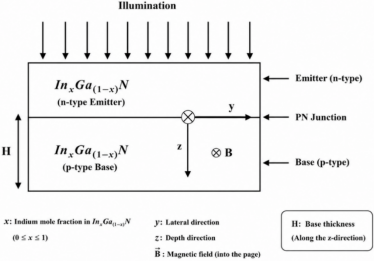
Figure 1. Schematic diagram of an InGaN-based solar cell under monochromatic illumination.
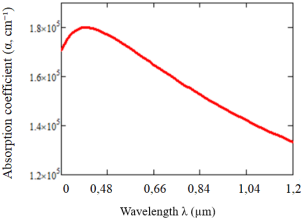
Figure 2. Impact of wavelength and indium fraction on the absorption coefficient
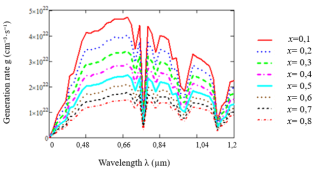
Figure 3. Variation of the carrier generation rate as a function of the normalized wavelength for different indium compositions and depths within the base region (z = 2 µm).
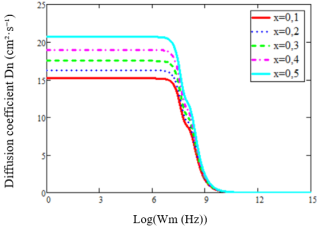
Figure 4. Variation of the minority-carrier diffusion coefficient with modulation frequency for various indium mole fractions, under the conditions B=5×10⁻⁵ T.
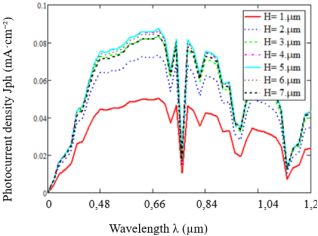
Figure 5. Photocurrent density profile as a function of wavelength for different values of thickness H for λ = 0,68 µm, B = 5 T, Sb = 2 × 10² cm·s-1 et Wm = Hz.
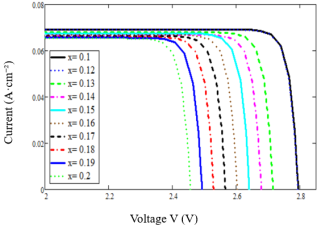
Figure 6. Current-voltage (I-V) characteristics as a function of the indium fraction x for: λ = 0,68 µm, B = 5 T, Sb = 2 × 10² cm·s-1 et Wm = Hz.
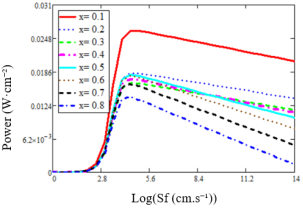
Figure 7. Effect of the composition x on the electric power of an InGaN cell for x = 0,1, λ = 0,68 µm, N = 10¹⁹ , B = 5 T, Sb = 2 × 10² cm·s-1 et Wm = Hz.
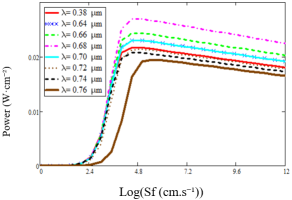
Figure 8. Influence of wavelength on the power of InGaN cells for Wm = 8 × 10⁸ Hz, x = 0,1, , H = 1,5 µm et B = 5 × 10⁻⁵ T.
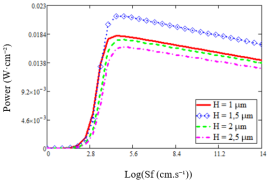
Figure 9. Influence of Thickness on the Power of InGaN Solar Cells at Wm =8×10⁸ Hz, x=0.1, λ=0.68μm, Sb=2×10²cms−1, and B=5×10⁻⁵T.
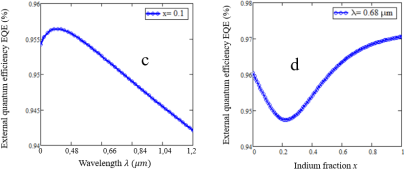
Figure 10. External quantum efficiency (EQE): (c) as a function of wavelength for x = 0.1, (d) as a function of the indium fraction x at λ = 0.68 µm.
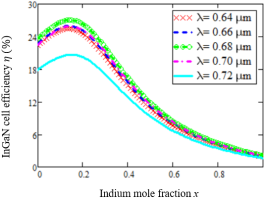
Figure 11. Efficiency of the solar cell as a function of the indium fraction x for different wavelengths: Wm = 8 × 10⁸ Hz, x = 0,1, Sf = 2 × 10² cm·s-1, Sb = 2 × 10² cm·s-1, H= 1,5 µm and B = 5 × 10⁻⁵ T.

Information



 Share This Article
 Twitter
 Linked In
 Facebook
 Copy
Copy Download